Why Old San Jose Homes Sink: The Clay Soil Connection
If you own an older home in San Jose, you may have noticed your floors aren't quite level anymore. That subtle slope or dip in the living room, the doors that stick in their frames, or the way marbles roll across the floor without any help are all telltale signs of a deeper problem: foundation settlement caused by expansive soil.
The Santa Clara Valley, where San Jose is located, sits on a geological foundation rich in clay. Unlike sandy or rocky soils, clay is highly reactive to moisture. When clay absorbs water, it expands. When it dries out, it shrinks. This constant cycle of expansion and contraction puts enormous stress on home foundations, particularly those built before modern foundation engineering standards were established. Homes constructed in the 1950s through 1980s are especially vulnerable because they often rest on shallow foundations that lack the reinforcement and drainage systems used in newer construction.
As the soil beneath your foundation shifts and settles unevenly, the support structure above it moves too. Floor joists, which are designed to be level and properly supported, begin to sag. This sagging isn't just cosmetic. It's a structural issue that can worsen over time and compromise the integrity of your entire home.
How Sagging Floors Develop and Progress
Foundation settlement rarely happens overnight. Instead, it's a gradual process that accelerates or stabilizes depending on soil conditions, drainage, and the home's age. In the early stages, you might notice nothing at all. But as months and years pass, the damage becomes visible and eventually impossible to ignore.
The progression typically begins with minor cracks in drywall or grout, especially around door and window frames. These cracks appear because the foundation is moving, and the wall structure above it is being pulled or compressed. Simultaneously, the floor joists that span between foundation walls or support beams begin to lose their level. A floor that was once perfectly flat now has a slight bow or sag in the middle of the room. In severe cases, the sag can be an inch or more, creating a noticeable slope that you can see and feel when you walk across the room.
If the sagging continues unchecked, the damage can extend beyond cosmetic issues. Floor joists can develop cracks or even fail completely. Subflooring may separate from the joists or rot if moisture infiltrates from below. This is where Floor Joist & Subfloor Repair becomes necessary. Additionally, if the foundation movement has allowed water to accumulate in crawl spaces or basements, Wood Rot & Dry Rot Repair may also be required to address decay in structural members.
Expansive Soil Foundation Repair: Understanding Your Options
Fixing a sagging floor caused by expansive soil foundation problems requires a multi-layered approach. The goal is twofold: stabilize the foundation to prevent further settlement, and then repair or reinforce the structural members above it that have been damaged by the movement.
The first step is always a professional foundation inspection and soil assessment. Engineers will determine whether the foundation has stabilized or is still moving. If the soil is still shifting, the foundation may need underpinning, which involves installing steel piers or helical anchors deep into stable soil layers beneath the clay. This is a specialized task that requires licensed structural engineers and experienced contractors. Once the foundation is stabilized, attention turns to the floor structure itself.
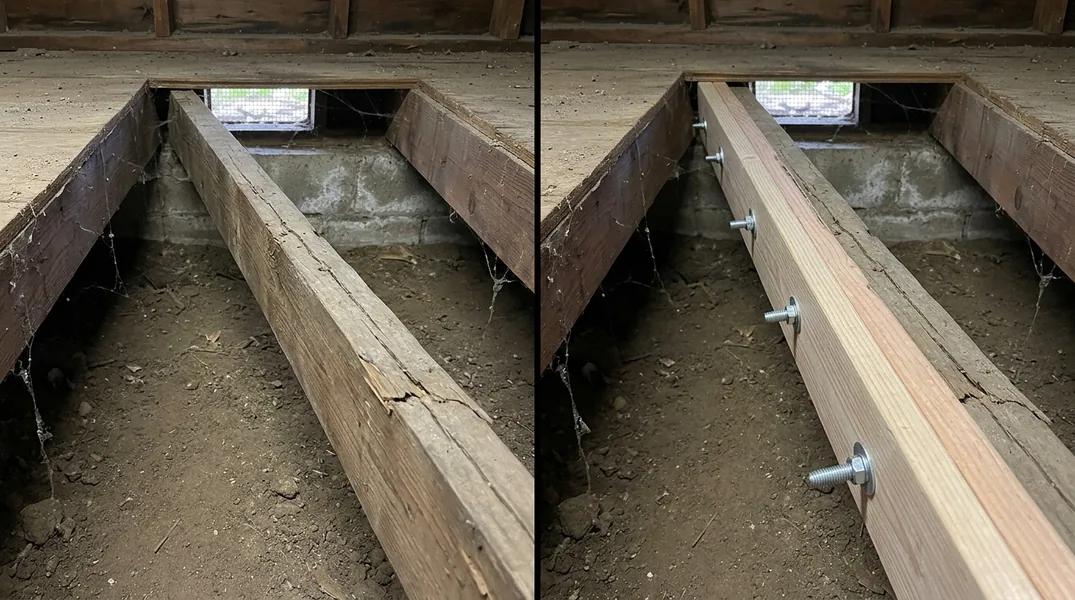
Repairing sagging floor joists typically involves one of two approaches: sistering or replacement. Sistering floor joists means installing new lumber alongside existing damaged joists and bolting them together to share the load. This method works well when the original joists are still structurally sound but need additional support. For severely damaged joists, full replacement may be necessary. In either case, proper support must be maintained during the repair process, often using temporary shoring and adjustable posts to distribute loads safely.
Controlling moisture and improving drainage around the foundation is equally critical. If expansive clay soil remains saturated, it will continue to swell and cause problems. Installing or improving perimeter drainage, adding gutters and downspouts that direct water away from the foundation, and ensuring proper grading around the home can significantly reduce soil moisture and slow or stop future settlement.
Sagging Floor Repair Cost in San Jose: What to Budget
The pricing for sagging floor repair varies dramatically depending on the severity of the problem, the size of the affected area, and the underlying cause. A simple sistering job on a few floor joists in a small area might cost between $3,000 and $7,000. More extensive repairs involving multiple joists across a larger span could run $10,000 to $25,000 or more. Foundation underpinning with steel piers, which is often necessary to stop ongoing settlement, typically costs $15,000 to $50,000 depending on the number of piers required and soil conditions.
It's important to understand that these are not one-size-fits-all estimates. A home with a 1,500 square foot footprint and moderate sagging will cost less to repair than a 3,000 square foot home with severe foundation movement affecting multiple rooms. Additionally, if the sagging has caused secondary damage such as Wood Rot & Dry Rot Repair or Termite Damage Repair, those services will add to the total project cost.
The best way to understand what your specific repair will cost is to request a free estimate from a qualified contractor. San Jose Carpentry offers comprehensive inspections and detailed quotes that break down labor, materials, and any structural engineering fees. Call (669) 202-8707 to schedule an assessment of your home's foundation and floor condition.
DIY Inspection: Signs Your Floors Need Professional Attention
Before you invest in professional repairs, you can perform a basic inspection to determine whether your sagging floors warrant immediate attention. Start by placing a marble or ball on your floor in several rooms and observing whether it rolls. If it does, your floor has a noticeable slope. Next, look for visible cracks in drywall, particularly in corners where walls meet ceilings or around door and window frames. These cracks often run diagonally and indicate foundation movement.
Check for soft spots in the floor by walking across rooms and noting any areas that feel bouncy or give slightly under your weight. This suggests weakened joists or subflooring. If you have access to a crawl space or basement, inspect the underside of the floor. Look for visible sagging in the joists, water stains, mold growth, or evidence of pest damage. Measure the deflection of the floor from below using a straightedge and tape measure, or simply note whether the joists appear to bow downward in the middle of their span.
If you observe any combination of these signs, professional evaluation is essential. Structural problems don't resolve themselves and typically worsen over time. The longer you wait, the more damage can accumulate and the more expensive repairs become.
When to Call a Professional: Floor Joist Repair Near Me
Sagging floors and foundation settlement are not problems homeowners should attempt to fix alone. The structural systems involved are complex, and mistakes can create safety hazards or make the problem worse. A qualified contractor with experience in Floor Joist & Subfloor Repair will have the knowledge, tools, and insurance necessary to perform the work correctly.
San Jose Carpentry specializes in diagnosing and repairing foundation and structural issues in older homes throughout the area. Our team works closely with structural engineers to ensure that repairs address the root cause of sagging, not just the symptoms. Whether your home needs sistering, joist replacement, foundation stabilization, or a combination of repairs, we develop a customized plan tailored to your home's specific conditions and your budget.
Don't let sagging floors become a safety concern or a barrier to selling your home. Contact San Jose Carpentry today at (669) 202-8707 or request a free estimate to learn what your repair will cost and how quickly we can restore your home to proper condition. We serve homeowners throughout San Jose and the surrounding communities with professional, reliable structural repair services.
Looking for a professional carpentry contractor in San Jose? San Jose Carpentry responds fast for all your carpentry needs.
Get a Free QuoteOur services: Wood Rot & Dry Rot Repair · Termite Damage Repair · Floor Joist & Subfloor Repair