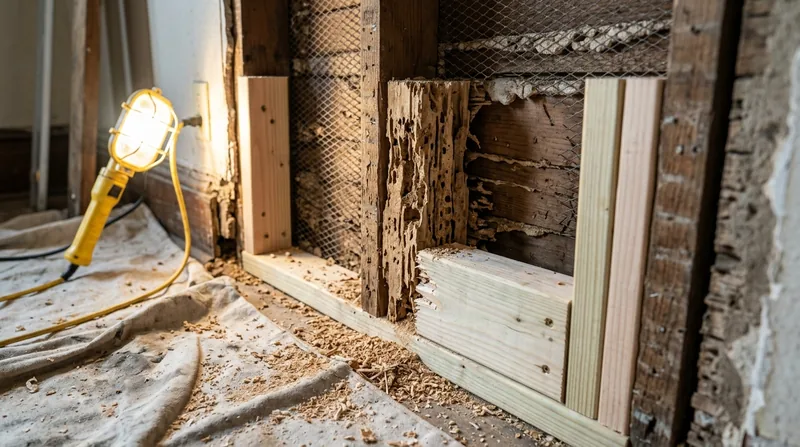




Termite Damage Repair in San Jose means rebuilding the wood your exterminator has identified as compromised. After drywood or subterranean termite treatment, the structural members, sills, studs, and subfloor sections that have been hollowed out still need to be replaced to restore full integrity to your home. San Jose's Craftsman bungalows, Victorian estates in Willow Glen and the Rose Garden, and postwar ranch homes across Cambrian and Blossom Valley all face termite pressure on the flat Santa Clara Valley floor, where clay and adobe soils and seasonal moisture cycles create conditions that favor both drywood and subterranean colonies. We remove the damaged wood, sister or replace structural framing, and restore load-bearing capacity so your home stands solid again. This is not pest control, it is carpentry work that follows your pest inspection report.
Why Termite Damage Repair Matters in San Jose Homes
Termite damage is not cosmetic. Once an exterminator treats a colony, the wood that has been eaten through is structurally weakened, and that weakness does not improve with time. Studs lose load-bearing capacity, floor joists sag under weight, sill plates rot away from the foundation, and subfloor sections become soft or hollow. A home that feels solid today may develop sagging floors, cracked drywall, or doors that no longer close properly within months if the damaged wood is left in place. The repair window is now, while you have a clear pest report and can address the damage before secondary moisture, settlement, or further deterioration compounds the cost.
- We replace termite-damaged studs, plates, and rim joists to restore framing integrity and stop future settlement.
- We sister or fully replace compromised floor joists and subfloor sections, returning full load capacity to sagging or soft floors.
- We restore sill plates and foundation connections where termites have hollowed out the wood at the base of exterior walls.
- We document all repairs for your insurance claim, with before-and-after photographs and a detailed scope of work.
Once the damaged wood is gone and sound framing is in its place, your home's structural integrity is restored and the risk of further settlement or failure is eliminated.
Key info: San Jose's clay and adobe soils retain moisture longer than sandy soils, and the Guadalupe River and Coyote Creek corridors create localized humidity that favors subterranean termite activity. Homes in Alviso, near the bay, and in low-lying areas of Blossom Valley and Evergreen see higher termite pressure than hillside properties. Check your pest report carefully for the extent of damage before deciding on repair scope.
For more detail on wood damage and repair strategies, see our Wood Rot and Dry Rot Repair page, which covers similar structural carpentry principles.
For information on permits and contractor requirements in San Jose, the City of San Jose Building Department provides guidance on when structural repairs require inspection or permits.
How We Repair Termite Damage in San Jose: Step by Step
Our process begins with your pest inspection report. We use that document as our scope of work, identifying every section of wood that has been compromised. We then assess whether each piece can be repaired or must be replaced, and we plan the work to minimize disruption while restoring full structural capacity. For studs and plates, we often sister sound framing alongside the damaged member, transferring the load and stabilizing the wall. For floor joists and subfloor, we typically replace the entire section to ensure level, solid flooring. For sill plates and rim joists at the foundation, we remove the damaged wood and install pressure-treated replacements, protecting against future moisture intrusion.
- We inspect the damage in person, confirm the scope against your pest report, and provide a detailed estimate for each section of work.
- We remove termite-damaged wood carefully, taking care not to disturb sound framing or finishes beyond the repair zone.
- We sister or replace studs, plates, and rim joists with pressure-treated or solid wood, matching the original species and dimension where possible.
- We replace compromised floor joists and subfloor sections in full, restoring level, solid flooring and eliminating soft spots or sag.
- We restore sill plates and foundation connections, ensuring moisture-resistant installation and proper bearing on the foundation.
- We close up walls, refinish trim, and restore the room to its original condition once framing repairs are complete.
This methodical approach means your home is fully repaired and the termite damage is eliminated from your structure.
Example: A 1920s Craftsman bungalow in Willow Glen had drywood termite damage in the wall studs behind the living room bookshelf and in the subfloor below. We sistered the studs with pressure-treated lumber, replaced the compromised subfloor section, and refinished the trim and baseboard to match the original. The floor is now level, the wall is solid, and the owner has a documented repair for the insurance file. Total time on site was three days.
For more on structural framing repair, see our Framing and Structural Carpentry page. For floor-specific damage, our Floor Joist and Subfloor Repair service covers the details of restoring sagging or soft floors.
Termite Damage Repair Methods and Approaches
| Approach | Description | Best for |
|---|---|---|
| Sistering | Install a new pressure-treated or solid stud or plate alongside the damaged member, bolted together to share the load. | Wall studs, plates, and rim joists where the original wood can remain in place and the new member takes the structural load. |
| Full Replacement | Remove the entire damaged member and install a new one, matching the original dimension and species where possible. | Floor joists, subfloor sections, sill plates, and any structural member where the damage is too extensive for sistering. |
| Pressure-Treated Installation | Use pressure-treated lumber for sill plates, rim joists, and any wood in contact with soil or prone to moisture, reducing future termite risk. | Foundation-level framing, crawlspace members, and exterior-facing wood where moisture or pest exposure is high. |
| Selective Section Repair | Replace only the hollowed or soft section of a longer member, such as a floor joist or rim joist, while leaving sound wood in place. | Long joists or plates where damage is localized to one section and the rest of the member is solid and sound. |
Termite Damage Repair Cost in San Jose: What to Expect
Termite damage repair costs depend on the extent of damage, the number of members affected, and whether the wood can be sistered or must be fully replaced. A small repair affecting one or two studs or a short section of subfloor may run from $1,200 to $2,500. A larger job involving multiple joists, extensive subfloor, and sill plate replacement can range from $3,500 to $8,000 or more. The single biggest factor is the scope: how many linear feet of framing, how many joists, whether the damage extends to the sill plate or foundation connection. Access also matters, because work in a crawlspace or behind finished walls takes longer than work in an open basement or accessible area.
We always recommend getting two or three estimates from local carpenters so you can compare scope, materials, and labor. Your pest inspection report is the roadmap, and a good carpenter will use it to identify exactly what needs to be repaired or replaced. Some damage that looks extensive at first glance can be addressed with sistering, which costs less than full replacement. Other damage, especially in floor joists or subfloor, often justifies replacement because the cost difference is small and the result is more durable.
For a detailed pricing breakdown and examples of how we estimate different types of termite damage, see our full pricing page. We provide free estimates with no obligation, and we respond within 24 hours at (669) 202-8707.
Termite Damage Repair Near Me: What to Look for When Hiring a Carpenter in San Jose
When you are ready to hire a carpenter for termite damage repair, a few key factors will help you choose the right contractor. First, confirm that the carpenter is fully insured and carries general liability and workers compensation coverage. Second, ask for references from recent termite repair jobs, and call them to ask about the quality of the work, the accuracy of the estimate, and whether the job was completed on time. Third, get multiple estimates and ask each carpenter to explain their approach: whether they plan to sister or replace, which materials they recommend, and why. Fourth, if your home is in a historic district or a neighborhood with design guidelines, check whether your local planning office or homeowners association has any requirements for the materials or methods you use. Finally, confirm that your carpenter understands the scope from your pest inspection report and will document the work for your insurance file.
- Ask whether the carpenter carries full insurance and can provide a certificate of insurance for your records.
- Request references from at least two recent termite damage repair projects and follow up with those homeowners.
- Get written estimates from two or three carpenters and compare the scope, materials, and timeline for each.
- Confirm that the carpenter will take before-and-after photographs and provide a detailed invoice for your insurance claim.
- Check with the San Jose Planning Department or your HOA if your property is in a historic district or gated community with design or material restrictions.
- Ask about the carpenter's experience with your home's era and style, whether it is a Craftsman bungalow, Victorian estate, or postwar ranch.
A local carpenter who knows San Jose homes and has strong references will give you confidence that your repair is done right the first time.
For more information and to request a free estimate, contact us online or call (669) 202-8707. We are fully insured and EPA Lead-Safe Certified, and we have been repairing San Jose homes since 2016.
Termite Damage Repair in San Jose: Pricing Guide
| Service | Price | Details |
|---|---|---|
| Small termite damage repair (1-2 studs or short subfloor section) | Starting at $1,200 | Sistering studs, replacing short joist sections, or sill plate work in accessible areas with minimal finishes to restore |
| Medium damage repair (multiple studs, floor joist, or extended subfloor) | Starting at $3,500 | Multiple structural members, longer subfloor sections, or sill plate replacement requiring more labor and materials to restore |
| Extensive termite damage (multiple joists, large subfloor section, foundation connection work) | Starting at $6,000 | Comprehensive framing repair, extensive subfloor replacement, or sill plate and rim joist work affecting multiple areas of the home |
| Complex or large-scale job (whole-room subfloor, extensive wall framing, or crawlspace repair) | On estimate | Scope requires on-site inspection to assess access, material requirements, structural complexity, and timeline before pricing |
| Travel and site visit | Included | No separate mileage fee or travel charge for San Jose, Santa Clara, Sunnyvale, Cupertino, and surrounding service areas |
| Free estimate | No cost | Response within 24 hours, detailed scope and materials review, no obligation to book, call (669) 202-8707 |
Indicative pricing, the exact cost depends on square footage, finish, and site access. Free personalized estimate within 24h at (669) 202-8707.


